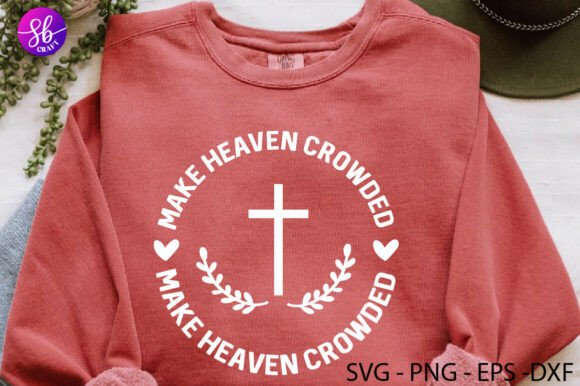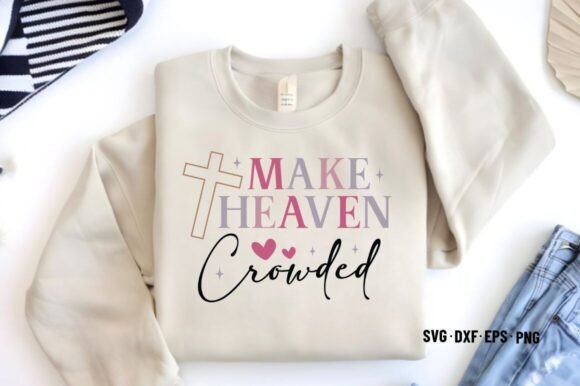
Make Heaven Crowded – SVG
A Designer’s First Glance: Warm, Witty, and Worn-Well
Opening Make Heaven Crowded – SVG feels like flipping through a well-loved sketchbook—there’s gentle confidence in the lettering, a soft rhythm to the spacing, and a quiet reverence beneath the humor. It’s not loud or ornate; it’s conversational, with subtle curvature in the letters and just enough weight to hold its own on fabric. As a designer who’s stitched hundreds of phrases onto baby onesies, boutique aprons, and holiday tea towels, I immediately saw where this would land: on a linen pillow cover for a nursery, a charcoal sweatshirt for a hospice volunteer group, or a woven cotton tote bag sold at a local craft fair. The mood is tender but grounded—spiritual without being solemn, personal without being private.
Where This Embroidery File Truly Shines
Make Heaven Crowded – SVG works best when the message matters more than the flash. I tested it as a machine embroidery design for a small-batch run of organic cotton kitchen towels—hooped with medium-weight cutaway stabilizer, stitched in matte cotton thread (ecru on navy, charcoal on oat). The result? Clean, legible, and quietly meaningful. Customers paused longer at that display. One buyer told me she bought two: one for her mother who’d recently lost her husband, another for her sister’s baby shower—same phrase, two different kinds of love.
It translates beautifully to embroidered patches (especially fused-on twill), custom apparel for faith-based nonprofits, and personalized gifts where sincerity outweighs trendiness. As an applique design, it holds up well on textured fabrics like terry cloth or looped fleece—but only if you simplify the stitch plan slightly to avoid overfilling curves. On baby embroidery projects, it reads clearly even at 3.5" wide, which makes it ideal for onesie hems or bib corners. For Etsy sellers, it’s a strong digital embroidery file for listings tagged “meaningful gift,” “nursery decor,” or “thoughtful embroidery.”
Real-World Stitching Notes You’ll Want Before Hooping
- Small hoop sizes: Works cleanly down to a 4”x4” hoop—but avoid going smaller. The descenders on the “y” and “d” need breathing room, and tight corners can blur in dense fill stitch.
- Textured or stretchy fabric: Use tear-away + light cutaway stabilizer combo. On knits or jersey, baste first and reduce top tension slightly—the script’s gentle flow can distort if the fabric shifts mid-stitch.
- Dark fabric: Test thread colors thoroughly. A soft heather gray or deep rust reads warmer and more intentional than stark white. Avoid neon or metallics—they undercut the design’s sincerity.
- Curved surfaces (caps, curved pillow fronts): Not ideal for direct cap embroidery unless resized and re-digitized for low-profile stitching. The natural curve of the phrase fights the dome shape—better suited for flat panels like back pockets or front chest placements.
- Frequent washing: Reinforce with a light zigzag satin stitch outline on final pass if using on tea towels or baby items. Standard fill stitch holds up fine, but that extra edge keeps letterforms sharp after 20+ washes.
What This Design Says—Before a Single Thread Is Cut
As a craft business owner, your embroidery file isn’t just data—it’s part of your brand voice. Make Heaven Crowded – SVG carries quiet professionalism. It doesn’t scream “handmade!” with flourishes or borders; instead, it trusts the words—and your execution—to carry weight. That builds customer trust, especially for personalized gifts or boutique branding. When used on a handmade product like a linen napkin set or a hand-stitched patch, it elevates perceived value—not because it’s complex, but because it’s considered.
I’ve seen similar phrases fall flat when digitized too tightly or scaled awkwardly. This one avoids that trap. The spacing between letters allows breath; the stroke weight stays consistent across sizes; and the overall silhouette remains balanced whether stitched at 2.75” on a child’s cap or 6” across a throw pillow. That consistency matters for Etsy sellers curating cohesive shop collections or small shop owners building repeatable product lines.
Practical Designer Checks—Non-Negotiable
- Test the embroidery file on scrap fabric *first*—especially if pairing with textured weaves or blends.
- Check thread color contrast in both natural and artificial light. What reads softly in daylight may vanish under café lighting.
- Review stitch density visually—not just in software. Overly dense fills on script fonts can cause puckering on lightweight cotton.
- Confirm hoop size compatibility with your machine before batching orders. Some versions of this design may include alternate sizing—check your file folder.
- Inspect small details: the tail of the “y,” the crossbar on the “t,” the terminal curve of the “d.” These define legibility at smaller scales.
- Run black-and-white mockups. Does it retain character in monochrome? Yes—this design does, making it versatile for printable mockups and social media previews.
- Compare performance on light vs. dark backgrounds. Its warmth shines on natural fibers, but can feel muted on high-sheen polyester.
- Verify licensing terms before selling finished items or bundling the digital embroidery file with other design assets. Since this is listed under Crafts and Graphics, assume personal and small commercial use unless otherwise stated—always double-check.
Final Thought: A Phrase That Stitches Like It Means It
Make Heaven Crowded – SVG won’t dominate a tradeshow booth or trend on TikTok—but it will live on a grandmother’s quilt, get folded into a hospital discharge bag, sit beside a candle on a grief counselor’s shelf, and show up handwritten on a card tucked inside a handmade soap bundle. That’s the mark of a truly functional embroidery design: it serves the moment, not the algorithm. For designers, Etsy sellers, and craft business owners who build products around meaning—not just motif—it’s a rare, reliable asset. Just remember: let the words breathe, honor the fabric, and stitch it like someone’s holding it close.